








|
Получение вашего Троицкий аудио Игрок готов ...
|
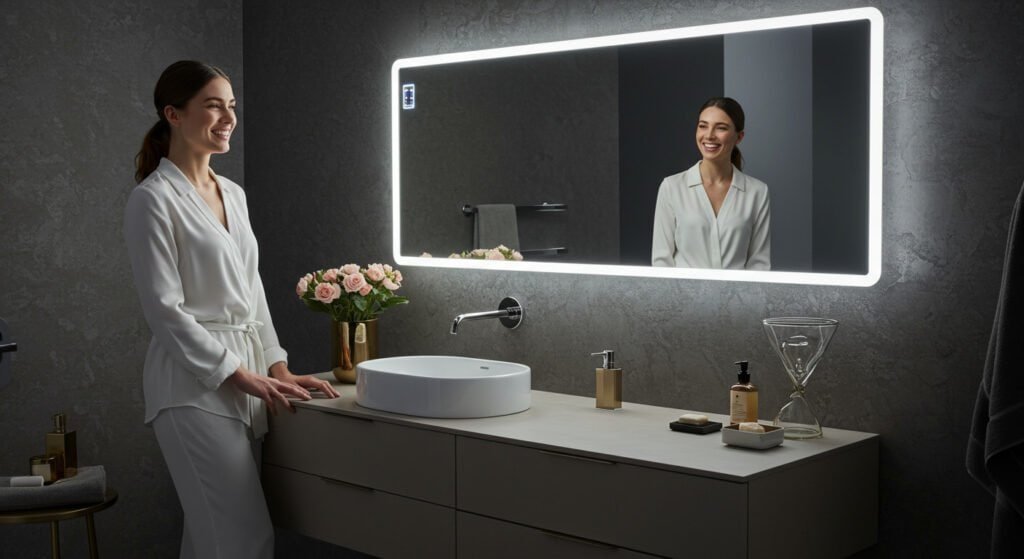
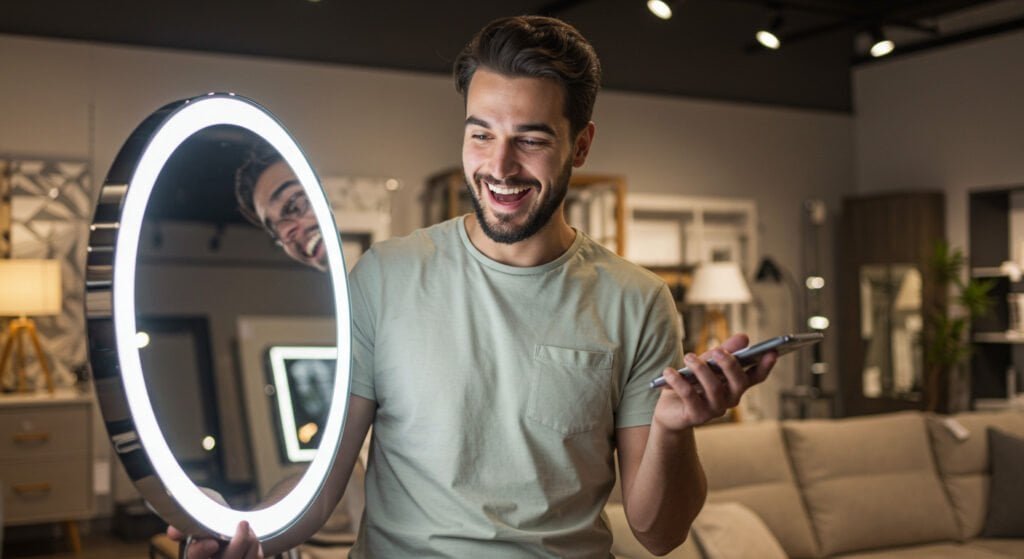
Is the mirror more accurate or camera?You check the mirror and feel good. Then a photo surfaces and your confidence evaporates. Which version is actually you — and why does the gap feel so enormous?
Ни зеркало, ни камера не показывают идеально точное изображение.. A mirror flips your face left to right — showing a version no one else ever sees. A camera captures the un-flipped version but distorts it through the lens, освещение, and by freezing one split second of your face. For most people, a photo taken with the rear camera from 6–10 feet away in natural light is the closest thing to how others actually see you.
Let’s break down exactly what each one gets right, what each one gets wrong, and what you can do about it.

How Does a Mirror Form Your Image — and Where Does It Go Wrong?
Most people assume a mirror is the most accurate tool they have. It’s right in front of you, it moves when you move, and it feels completely real. But it introduces one unavoidable problem that almost nobody thinks about.
A mirror bounces light off a shiny, silver-coated surface back to your eyes — but it always flips your face left to right in the process. This means your left side shows up on the right, and your right side shows up on the left. Because no one’s face is perfectly even on both sides, this flip creates a noticeably different image from what other people see when they look at you. Mirror quality also matters — cheap, thin glass can slightly warp your image without you ever noticing.
Here’s the simplest way to see this for yourself: raise your right hand in front of a mirror. Ваше отражение поднимает левую руку. Your brain has been looking at that flipped version of your face every single morning since you were a baby, so it feels completely normal. But here’s the thing — that flipped version of your face? Nobody else has ever seen it. Not your friends, not your family, not your coworkers. They see the un-flipped version, which is what a camera captures. So when a photo feels slightly “выключенный” to you, it’s not because the photo is wrong. It’s because you’re seeing your face from an unfamiliar angle for the first time.
Beyond the flip, glass quality genuinely matters. Good bathroom vanity mirrors use glass that’s at least 5mm thick with a proper silver coating on the back. This gives you a flat, честное размышление. Cheaper mirrors use thinner glass with a weaker backing — and that can warp your image just enough to change how your proportions look, without you ever realizing it.
How Does a Camera Capture Your Image — and Where Does It Go Wrong?
A camera feels like it should be perfectly honest — it’s a machine, it just records whatever is in front of it. But cameras have their own ways of making you look different from how you actually appear, and some of them are pretty significant.
A camera captures light through a lens and turns it into a flat, two-dimensional image. The type of lens makes a big difference to how your face looks. The wide lens used in most phone front cameras makes whatever is closest to it look bigger — and when your face is 12 inches from the phone, that’s usually your nose. Professional portrait photographers use a different type of lens (roughly 50–85mm) that shows faces much more naturally, because it’s closer to how human eyes actually see things.
There are four main ways a camera makes you look different from real life. Первый, the wide-angle lens on your phone’s front camera stretches and enlarges whatever is closest to it — usually the middle of your face. Второй, it flattens your three-dimensional face into a completely flat 2D image, removing all the natural depth that makes faces look like faces. Третий, it freezes one random split second of your face — not you mid-laugh or mid-conversation, but one single moment you’d never consciously choose to represent yourself. And fourth, bad lighting (like a ceiling light overhead) creates shadows under your eyes and chin that don’t exist in real life.
Your phone’s front camera manages to do all four of these things at the same time. The result is technically a real photo of you — but it misrepresents how you actually look in more ways than a mirror ever does.
Which Looks More Realistic — Mirror or Camera?
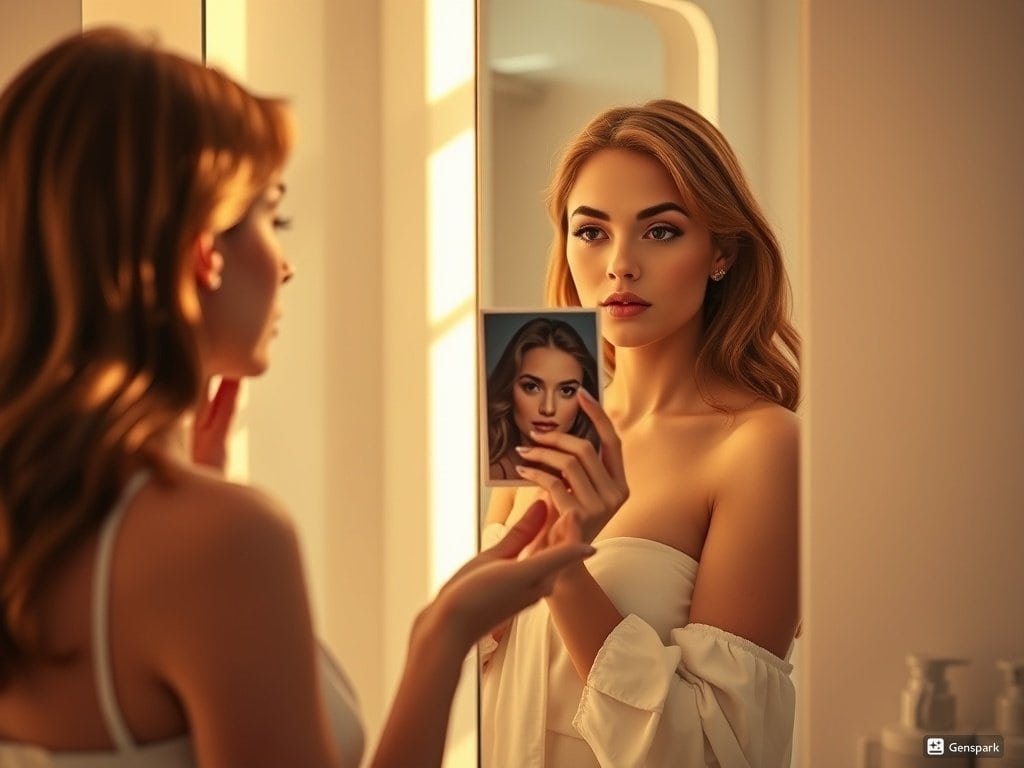
“Realistic” и “accurate” are two different things — and this is exactly why people prefer their mirror image but don’t trust their photos.
A mirror feels more realistic because it shows you moving, blinking, and adjusting in real time — in three dimensions, just like actual life. A camera catches one frozen moment, squashed into a flat image, often under bad lighting. But feeling realistic and being accurate aren’t the same thing. The mirror shows a more lifelike experience of your face, while a photo taken correctly is actually closer to the version of you that the rest of the world sees every day.
Когда ты смотришь в зеркало, you see yourself in motion — smiling, adjusting your hair, tilting your head. That feels completely natural and lifelike. But here’s the catch: that “realistic” experience you’re seeing in the mirror has still been flipped left to right. Nobody else has ever seen that version of your face. A camera, despite all its flaws, captures your face in the correct orientation — the way your friends, family, and everyone you’ve ever met sees you. So the most “realistic” view of yourself, in the sense of matching how others actually experience you, isn’t the mirror — it’s a photo taken from a normal distance with the rear camera in good light.
Зеркало против камеры: Which One Is Actually More Accurate?
This is the main question — and it deserves a straight answer, not a vague “well, it depends.”
Between the two, a camera — specifically the rear camera, used from at least 6 футов далеко, in good natural or LED lighting — is more accurate for showing how others see you, because it shows your face the right way round without flipping it. But a high-quality mirror with good lighting is still the most useful daily tool for grooming and getting ready, because it gives you real-time, live feedback that no photograph can replicate.
Here’s a direct, honest comparison of both tools across the things that matter most:
| What You’re Checking | Зеркало | Rear Camera From a Distance |
|---|---|---|
| Which way your face is facing | Flipped left-right | Correct — matches what others see |
| 3D or flat? | 3D, real-time, lifelike | Flat 2D, frozen in one moment |
| Does it distort your features? | Only if the glass is cheap | Very little if you’re 6+ футов далеко |
| Can you control the lighting? | Да, with a good LED mirror | Depends on your environment |
| Does it show natural expressions? | Yes — full movement | No — one random frozen moment |
| Best for | Daily grooming, getting ready | Понимание того, как вас видят другие |
| How accurate vs. what others see | Close, but flipped | Most accurate for others’ perspective |
Neither one is perfect. The most complete picture of your appearance uses both: a high-quality lighted bathroom mirror for daily use, and the occasional rear-camera photo taken correctly for an outside check.
Which Is My Real Face — Mirror or Camera?
This sounds like a philosophy question, but it has a pretty interesting practical answer.

Both the mirror and the camera show real, accurate parts of your face — just from different viewpoints. The mirror shows your face from your own viewpoint, flipped. The camera shows your face from the world’s viewpoint, un-flipped. But neither one captures the complete truth, because your “real face” is three-dimensional, constantly moving, and always changing with your expressions. No flat surface or camera sensor can fully capture that.
Think of it this way: your real face is more like a sculpture than a photograph. It exists in three dimensions, it looks different from every angle, and it changes with every expression. A mirror and a camera are both just taking flat snapshots of that sculpture from different sides — one from the angle only you ever see (looking into your own mirror), and one from the angle everyone else sees (looking at you from across the room). Neither snapshot is the full sculpture.
If you genuinely want to see your “real face” as accurately as possible, the best option isn’t a fancier mirror or a better camera. It’s a short video clip taken by someone else, from normal conversation distance, при естественном свете. Video shows you in motion, with real expressions, from the correct un-flipped angle — which is as close to “real life” as any recording can get.
Why Do You Look Better in the Mirror Than in Photos?
This is probably the most searched self-image question on the internet — and the answer is part psychology, part camera physics.
You look better in the mirror than in photos mainly because of something called the Mere Exposure Effect — which is basically just the fact that we like things more the more we see them. You’ve looked at your mirror reflection thousands of times. Your brain has learned to see it as familiar and natural. Your photo face, which is slightly different (un-flipped), feels less familiar — and your brain automatically finds less familiar things less attractive, even when they’re objectively the same face.
The Mere Exposure Effect was discovered by psychologist Robert Zajonc in 1968 — he found that people develop a preference for things simply by seeing them more often, even if they don’t consciously remember seeing them before. Applied to your face: you like your mirror image because you’ve seen it your entire life. When people in studies were shown two photos of themselves side by side — one normal, one flipped to match the mirror — they almost always preferred the flipped version. But the people who knew them? They almost always preferred the normal, un-flipped one.
What this means in real life: the version of your face you find most comfortable and attractive in the mirror is the version nobody else has ever seen. And the version you find a bit uncomfortable in photos is the version everyone around you finds completely normal. They’re not being nice when they say you look good in a photo. They genuinely mean it — because that’s the face they’ve always known.
Why Is Your Phone’s Front Camera So Unflattering?
If your selfies never seem to match the person looking back at you from the bathroom mirror, you’re not imagining it. And it’s not your face that’s the problem — it’s the lens.
Phone front cameras use a very wide lens to fit more into the frame — which is great for group shots but genuinely bad for close-up faces. At a typical selfie distance of 12–18 inches, this wide lens makes whatever is closest to it look much bigger than it really is. That’s usually your nose. Professional portrait photographers use a completely different type of lens (50–85mm) precisely because it shows faces the way they actually look, without stretching or exaggerating anything in the center.

The easiest way to understand this is with an analogy. Have you ever seen photos taken with a fisheye lens, where everything in the center looks huge and everything at the edges curves away? Your phone’s front camera isn’t that extreme — but it works on the same principle. It’s a wide lens held very close to your face, and that combination exaggerates whatever is in the middle. Исправить это просто: переключитесь на заднюю камеру и попросите кого-нибудь сделать снимок хотя бы с 6 футов далеко. Задняя камера использует менее экстремальный объектив., and the extra distance removes almost all of the distortion. The photo will look dramatically more like the person you see in your bathroom mirror.
This is also exactly why professional headshots — the ones used on actor portfolios, LinkedIn, and company websites — are almost always taken from a distance with a longer lens. The photographers know that the front camera angle is the least flattering way to take a portrait, and they avoid it accordingly.
What Is the Most Accurate Way to See Yourself?
This is the question all the others have been building toward — and it has a clear, practical answer.
The most accurate way to see yourself as others see you: have someone take a photo with the rear camera of a phone from 6–10 feet away, in natural daylight or in front of a good LED bathroom mirror, with portrait mode turned on. This removes lens distortion (rear camera), fixes the proportion problem (distance), gives you honest color (good lighting), and shows your face the right way round — the way the rest of the world sees you every day.
Here’s a simple ranking of methods, from most to least accurate for understanding how you actually appear to other people:
| Метод | How Accurate? | Почему |
|---|---|---|
| Задняя камера, 6–10ft, естественный свет, модный портрет | Best | Closest to how others see you in real life |
| Задняя камера, 6–10ft, LED mirror light | Very good | Best option when there’s no window nearby |
| Профессиональный выстрел в голову (longer lens, good lighting) | Very good | Most flattering and true-to-life |
| Задняя камера, closer range | Decent | Less distortion than the front camera |
| Good LED mirror with proper lighting | Decent | Flipped, but great for daily real-time use |
| Phone front camera at selfie distance | Poor | Lots of wide-lens distortion |
| Basic mirror with overhead ceiling light | Poor | Flipped face plus unflattering shadows |
For everyday grooming, a top rated LED bathroom mirror is still the most useful tool you have. For understanding your objective appearance, combine it with the occasional correctly taken rear-camera photo.
How Does Lighting Affect Accuracy in Both Mirrors and Cameras?
Lighting is the hidden factor most people completely overlook — and it changes how you look in both mirrors and photos more dramatically than almost any other variable.
Two things about lighting make a huge difference: the color of the light and where it’s coming from. Overhead lighting shines down and creates unflattering dark shadows under your eyes, nose, and chin — making you look more tired and making features look more pronounced than they really are. Front-facing light — from a lighted bathroom mirror, a backlit mirror, or a window — removes those shadows completely and shows your face evenly and honestly. For color accuracy, light in the cooler, whiter range (closer to daylight) shows your true skin tone instead of making everything look yellow or orange.

Here’s a simple way to understand why this matters so much. Have you noticed that selfies taken near a window almost always look better than selfies taken under a bathroom ceiling light? Окно мягко окутывает, even light around the front of your face. The ceiling light hits the top of your head and throws everything below your eyebrows into shadow — like someone holding a flashlight above you. Это не лестно, и это не точно.
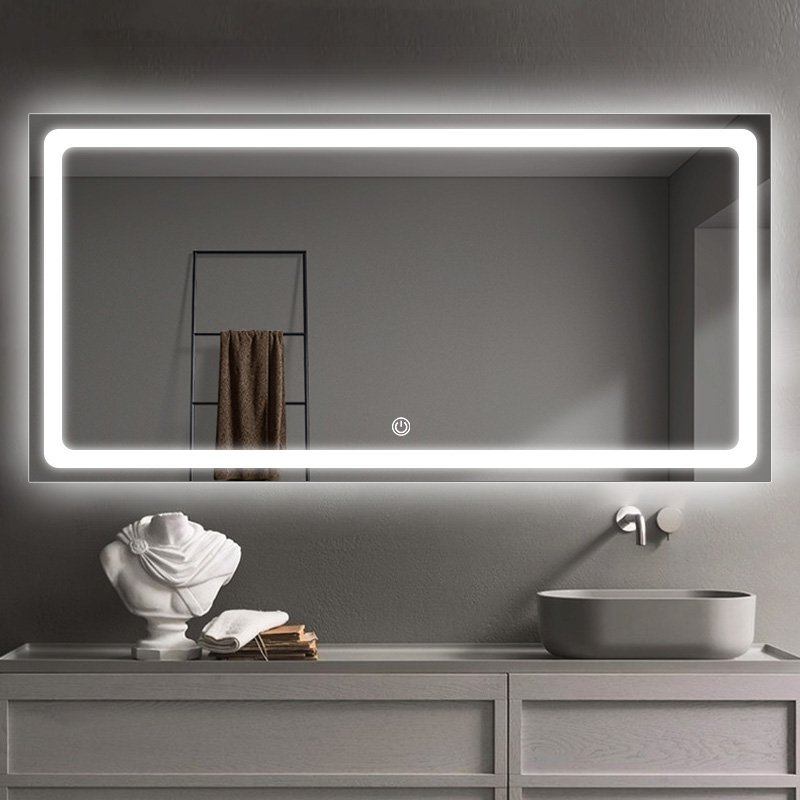
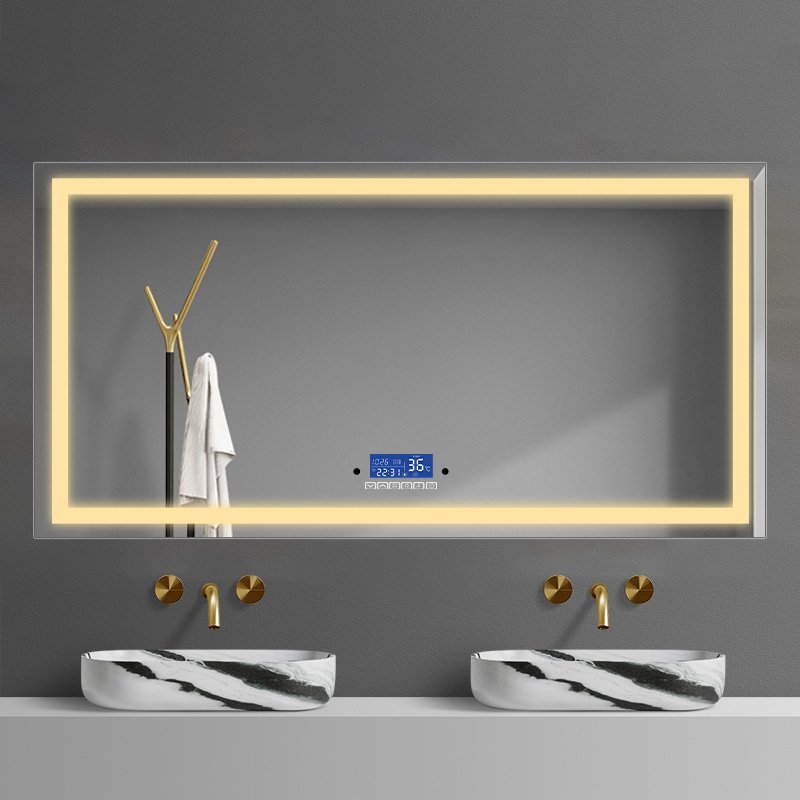
A bathroom light mirror or wall mirror with lights built into the frame works exactly like the window: it puts the light in front of your face instead of above it. This is the same setup professional photographers use — they always put lights at face level, never above. It’s why LED bathroom mirror reviews so often mention lighting quality as the single most important feature. The same face, lit from the front with adjustable LED light instead of from above with a ceiling bulb, looks genuinely and noticeably different. For anyone looking at lighted vanity mirrors for bathroom use, or any LED vanity mirror for home or commercial use, adjustable color temperature and even light distribution are the two specs that make the biggest real-world difference to how well it works.
Часто задаваемые вопросы
Is the Mirror or Camera More Accurate?
For daily grooming and getting ready, a high-quality mirror with good LED lighting is more полезный — it gives you live, three-dimensional, real-time feedback. For understanding how others actually see you, the rear camera from a normal distance in good light is more accurate — because it shows your face the right way round, without the left-right flip. The best approach combines both: a quality lighted bathroom mirror for everyday use, and the occasional correctly taken rear-camera photo to get an outside perspective.
Do I Look Better in Real Life Than on Camera?
Almost certainly yes — for two main reasons. В реальной жизни, people see you in three dimensions and in motion, which is far more representative and flattering than a frozen flat image. And most selfies are taken with the front camera at close range, which stretches and distorts facial features in ways the rear camera from a distance doesn’t. People who know you see a dynamic, three-dimensional version of you that no photo has ever fully captured.
Which Camera Is Most Accurate for Selfies?
For the most accurate result: use the rear camera from at least 6–8 feet away, have someone else hold the phone, use natural light or a good lighted vanity mirror for light, and turn on portrait mode. This setup removes wide-lens distortion, fixes the proportion problem that close-range selfies create, gives you honest lighting, and shows your face the way everyone else sees it — un-flipped.
Why Do I Look Good in the Mirror but Bad in Photos?
Three things stack up at once: (1) your mirror face is flipped, and your brain has spent years getting comfortable with that flipped version — so the un-flipped photo version feels subtly wrong, even when it’s actually more accurate; (2) phone front cameras use a wide lens that genuinely distorts close-up faces, making noses look bigger and faces look wider; (3) photos freeze one random moment of your face, without the movement and expression that make you look like yourself in real life. Switching to the rear camera from further away fixes most of problem (2) and makes a big dent in problem (3).
Заключение
Both the mirror and the camera have blind spots. The best self-image comes from pairing a quality LED mirror with good lighting — and occasionally using a rear-camera photo for an honest outside check. Questions? Contact Josie at [email protected].
Reach out to Josie at[email protected].
- Чтобы узнать, как выбрать правильное зеркало в ванной, нажмите здесь.
- Чтобы узнать, как установить зеркало выбирать здесь.
- Чтобы узнать, как выбрать зеркало правильного размера, нажмите здесь.
- Чтобы узнать, как изготовлены зеркала, нажмите здесь.
- Нажмите здесь, и вы узнаете, почему мы выглядим лучше в зеркалах.
- Нажмите здесь, вы узнаете о вершине 10 светодиодные производители зеркала для 2024.
- Нажмите здесь, чтобы узнать, почему мой тщеславный зеркальный свет не включается?
- Узнайте, какой рост должен быть зеркало в ванной? Кликните сюда
- Нажмите здесь, если вы не знаете, как почистить зеркало
- Чтобы узнать, как закрепить зеркало датчика сенсора, не работает, нажмите здесь
- Выяснить 10 Общие светодиодные проблемы с зеркалом в ванной комнате нажмите здесь
Looking for custom LED bathroom mirrors in any size, форма, or finish? Reach out to Josie at [email protected]. With 20 years of experience exporting mirrors to North America, South America, Ближний Восток, и Северная Африка, Hixen makes sourcing simple and reliable.